Showing posts with label Qatar. Show all posts

Tuesday, August 28, 2012

Look who's watching our fetish for gold


It’s not just we, Indians observing each other how much jewels we are wearing or if we are wearing anything at all. Now China joins our league and they are observing us, what jewels we are wearing, how much we are wearing. And you should not miss my previous post on the yellow metal and how it keeps attracting me like a magnet and I'm not ashamed to accept the fact that I have this fetish for gold, gold jewels. No need to get any weird ideas, all I mean is I love to invest in gold, to be more precise.

Let me come back to the point. Yes, “without gold nose ring, Indian women won’t go out,” says an article published on a Chinese daily. Ah, little too much, I don’t even have a nose ring, not just me many of us don’t even wear nose ring, but whatever be it, the Chinese are observing us very closely ;) 

People's Daily Online in its article “Indian beauties wearing gold jewelry” says, “In India it will be considered impolite if women go out without any jewellery.” Hmm, maybe times are changing and yes, I remember my mom often telling me that without some piece of gold on her body, woman looks incomplete. Maybe that’s the reason, even a worker at least adorns herself with as tiny as a gold nose ring.     

The article which features Bollywood actress Aishwarya Rai wearing jewels says, “Recently Indian government plans to issue “paper gold” that is to encourage people to purchase gold reserved in banks. Though buying “paper gold” doesn’t mean you can really take physical gold in hand, many Indian still scramble for this, which reflects Indian affection and reliance for gold.”

It’s not an exaggeration when the article mentions that among all kinds of jewellery, Indians prefer gold ones. “Indians have black skin and wearing gold jewelry can highlight this feature,” it says. I don’t remember myself wearing fake jewels and my family, relatives and many of my friends know that I love gold jewels. 
    
It’s a fact that Indian women wearing gold earrings and necklaces could be seen everywhere. “Even those little girls who beg along the roadside with an unkempt appearance have a gold nail in the nose,” it says. Yes, who will not love this glittering metal? I don’t think anybody would hate this metal, if not for wearing at least as an asset!   

Who can deny that men don’t wear jewels in India? “It is also very common that men wear jewelry. Many Indian men wear three rings with large pieces of jewels on them,” the article says. And here, I have a man, who hates wearing gold to the extent that he refuses to wear his wedding band and I have to force him to wear it once in a while! The moment he sees a gold commercial on TV, he switches channels, not because he hates gold, but because I love gold and I would put forth my demands in front of him... 

“In wedding ceremony, parents usually choose gold ornaments as daughter’s dowry, which not only set off the beauty of the daughter but can also serve as a kind of property in married life,” the article adds. It’s not rare that friends and relatives presenting gold jewels to show their blessings during weddings and other special occasions. It’s true that one day or the other gold will come to the rescue of the owners and parents want their daughter’s life to be secure, her future to be secure through gold. Not to forget the underlying fact that it has made the dowry system much more stronger in the country, as gold in kilograms is expected from a girl’s family. Maybe it’s one thing which is passed through generations and as it passes generations, it gains its value! While people these days fancy buying antique jewels, some generations have them passed to the present ones and such jewles are just priceless.  
   
No wonder, there are gold jewellery shops everywhere, from metros to small cities, in the country. And how can anyone miss the number of commercials and ads which are pumped through all media during festive seasons? And it is this craze which often makes a big hole in the pockets of men every year in the name of festivals, special occasions and gifts.     

Apart from all these, ever wondered why is China concentrating on India’s, Indians’ gold jewels? According to "Gold Demand Trends Q2 2012" recently published by the World Gold Council, the gold demand in China has dropped by 7 per cent in the second quarter of 2012. But here, one should not forget that China still ranks sixth in the world with a total gold reserve of 1,054.1 tonnes. Although China’s gold demand has grown slower than last year, the World Gold Council still forecasts the 2012 growth rate of the country’s gold demand at 10 per cent.

Plus, China may overtake India as the world's largest gold jewellery consumer in 2012. So China's gold market will exert significant impact on the global market. China remained the world's largest gold producer for the fifth year in a row in 2011, with the annual output rising by 5.9 per cent to more than 360 tonnes, according to the data from the China Gold Association (CGA).

Moreover, China's demand for gold jewellery currently accounts for over 30 per cent of the world's demand, making it the largest gold jewellery consumer for the third consecutive quarter. In the first quarter, the world's gold consumption dropped 5 per cent year-on-year to 1,097 tonnes, mainly because gold prices have surged 22 per cent from a year ago and because demand in India also fell significantly over the same period, said the WGC report.

Currently China and India account for some 50 per cent of the world's gold demand. But the Indian government has hiked jewellery taxes and raised gold import duties, said the WGC, which resulted in the sharp drop in first-quarter demand.

Attracting the consumers, China also has ATMs dispensing gold bars and coins. The first such ATM was activated in the capital's bustling Wangfujing shopping area in September 2011. Gongmei Gold Trading, which installed the ATM, expected the machine to be a big hit and hoped to have 2,000 similar ATMs in place within the next two years. “The majority will be in private clubs at banks and at landmark buildings in large cities,” the company had said.

And such gold vending machines are not exclusive for China. I have seen them in Burj Khalifa, Dubai, and yes our plans to buy one gold bar at the vending machine didn’t fulfill, as the quoted prices were much higher than the market price!

Such gold vending machines are already in use in countries such as Germany, the United States, Italy and the United Arab Emirates. Sorry, none in India! The touch-screen machines dispense gold bars and coins of various weights based on the market price of the metal, which is updated every 10 minutes.

Sigh, whatever be it, we Indians keep loving this metal and keep buying them, no matter how big hole they make in our family budget!

Wednesday, August 8, 2012

Counterfeit streetlights in Qatar


A nighttime drive down Al Waab Street toward the harbor in Doha, Qatar, puts one literally in the spotlight of what some are calling "one of the biggest cases of public counterfeiting in the history of design." That's what officials at the Spanish industrial design firm Santa & Cole think, anyway. They're the firm that designed the streetlights shining down on drivers along this roughly 10-kilometer stretch of road. Problem is, the 920 streetlights lining that roadway are alleged copies.

It may not be the biggest case of counterfeiting in the history of design, but it's likely the biggest in the history of streetlights.

Towering up and leaning over the street like splayed chopsticks, the streetlights are almost exact replicas of Santa & Cole's "Latina" streetlights, designed by architect Beth Galí and installed on streetscapes from Spain to Italy to the Netherlands. Qatar could have been another official entry on that list. In late 2005, Santa & Cole were invited to present a lighting design for transforming Al Waab Street ahead of Doha's hosting of the 2006 Asian Games. Those designs were then allegedly taken by the State public works authority, Ashghal, and sent to another firm to more affordably replicate the lights Santa & Cole had proposed.

Santa & Cole and Galí are so upset about the breach of intellectual property that they've launched an online campaign about the alleged counterfeit, QatarFakes.com. An extensive and document-rich timeline of the entire process is detailed on the site.

Despite a Cease and Desist letter [PDF], numerous attempts to negotiate, and an attempted arbitration through the World Intellectual Property Organization of the United Nations, the streetlights still stand in Doha.
Santa & Cole argues that the poorly built streetlights are not only a breach of intellectual property rights, but also create a negative impression of their design.

Officials in Qatar have declined to participate in any negotiations or arbitration related to the streetlights. With little recourse, Galí has filed a lawsuit against the State of Qatar with courts in Barcelona, which has the support of Santa & Cole, the Barcelona Center for Design and the Design For All Foundation. She calls the whole ordeal "a large-scale forgery case that is threatening the creativity of professionals and European companies." She's hoping the lawsuit will put an end to this years-long battle. For now, drivers in Doha will continue to navigate Al Waab Street under the glow of these controversial streetlights.

(Source: The Atlantic Cities

Monday, July 23, 2012

Qatar prisons ‘always open for rights bodies’


Officials of the National Human Rights Committee (NHRC), the human rights department at the Ministry of Interior (MoI) and the Red Crescent visit Qatar’s prisons regularly to make sure that prisoners enjoyed their full rights according to international standards.

“The doors of the prison are always open for these human rights organisations to conduct field visits inside the various departments and make sure for themselves about the standard of the services presented to prisoners,” said Colonel Mohamed Saud al-Utaibi, director of the Penal and Reformatory Institutions department of MoI at a recent interview with local Arabic daily Al-Watan.

Col al-Utaibi welcomed such visits and pointed out that these representatives could meet prisoners alone to hear from them about their rights. He also indicated that remarks of such organisations are usually very simple and are taken into consideration accordingly.

Col Al-Utaibi affirmed that the inmates, whether Qataris or expatriates have equal rights and duties governed by the prisons law no 4 for 1995, which does not distinguish between Qataris or non-Qataris.

“According to the applied regulations, each inmate has the right to make two phone calls a month. In addition, exceptional phone calls are allowed in case of necessity or for reasons estimated by the director of the department or prison officials. Further, non-Qataris are allowed to receive periodical phone calls from their relatives, whether they were inside Doha or abroad,” pointed out the director.

Col al-Utaibi said that recently new methods of communication have been adopted through the Internet such as Yahoo Messenger, Skype, Facebook and Twitter, which would be offered free for the inmates.

“This would make things easy, especially for foreign inmates, and ease the burden of cost on their relatives. This idea was highly received by the inmates and they are eagerly waiting for its launch. However, this would not in any way be an alternative for the usual visits they are entitled to,” he said.

He explained that prisoners are housed in wards according to the type of crime they had been convicted of. Some wards have two persons, and others four or six, according to the type of building.

“Classifying inmates is considered one of the modern approaches in penal treatment inside prisons and it is among the provisions of law no 4 for 1995. Each category of prisoners is classified into grades according to age, type of crime, criminal history, and similarity in social and cultural backgrounds. Each category is given special place at the prison to facilitate the process of rehabilitation,” said Col al-Utaibi.

He further pointed out that this classification serves the interests of prisoners themselves for some were not really criminals but were deluded into crime. Therefore, it is not proper to put them with “criminals that may adversely affect their conduct”.

Prisoners are kept occupied through a variety of constructive activities including handicrafts, agriculture, sports and different cultural activities. There is also a separate workshop for female prisoners, where they practise suitable crafts such as clothes making, and drawing. Currently there are 13 female inmates in the prison.

During Ramadan, inmates of each ward enjoy a quality group Iftar. “Recently the department has hired qualified cooks and the meals offered to inmates are excellent in quality and quantity,” said the director.

Non-Muslims are offered their meals in a normal manner and they abstain from eating in front of their Muslim counterparts in Ramadan as a way respecting their feelings. However, they share their Iftar and Suhoor to enhance the spirit of participation among them.

The present central prison was inaugurated on February 13, 1986 on Salwa Road.

“It was given a modern design taking into consideration that prisons are places for correction, rehabilitation and reform,” explained Col al-Utaibi.

The prison contains eight buildings and two new buildings have been added lately. Col al-Utaibi indicated that there is a plan to build two more new wards.

“The issue is not to find new buildings to accommodate more prisoners for the perspective of the Ministry of Interior is to reduce the rates of crime. Consequently, the number of prisoners would decrease, and this has been really achieved lately,” stressed Col al-Utaibi.

(Source: Gulf Times)

Wednesday, July 18, 2012

Child obesity alarming in Qatar


Childhood obesity has become one of the most serious public health challenges of the 21st century as its prevalence worldwide increased to 42mn children under five years in 2010, Hamad Medical Corporation’s Paediatric Endocrinology and Diabetes acting consultant Dr Ahmed el-Awwa has said.

“The prevalence of obesity in children has increased at an alarming rate and its prevalence in the last 10-20 years has tripled globally due to a lot of factors such as environmental triggers that will predispose obesity including bad diets and a lack of physical activities due to the proliferation of television, Internet, video games and smartphones,” he explained.

Speaking to Gulf Times on the sidelines of the inaugural symposium of the Sidra Medical and Research Centre’s symposia series recently, Dr el-Awwa observed that overweight and obese children are likely to stay obese into adulthood and they are more likely to develop diabetes and cardiovascular diseases at a younger age.

Some of the potential health risks with obesity according to Dr Awwa, who is also the Weill Cornell Medical College in Qatar’s clinical paediatrics instructor, include glucose intolerance, insulin resistance, Type 2 diabetes, hypertension, high cholesterol, hepatic steatosis, cholelithiasis (gallstones), orthopedic problems, obstructive sleep apnea, asthma, skin conditions and menstrual abnormalities.

“Obesity also has some psychological effects on the affected child such as low self-esteem, negative body image, depression, social stigma, teasing and bullying as well as discrimination,” he added.

Citing a past study conducted among Qatari adolescent boys (1,968) and girls (1,955), he mentioned that the obesity prevalence was highest among boys aged 12 years old (11.7%) and highest among girls aged 13 years (6.4%).

“Some 8.6% of the boys was found to be underweight while another 28.6% and 7.9% are overweight and obese respectively and among the girls, 5.8% was found as being underweight while 18.9% and 4,7% are overweight and obese in that order,” he explained.

Diets contributing to childhood obesity include high-calorie foods or beverages, which are high in sugar, fast foods, baked goods, junk snacks widely available at vending machines, soft drinks as well as candy and desserts.

“A more recent study on habits of food intake among children also found some unhealthy food habits including skipping breakfast, unhealthy snacking or eating fast foods more than twice per week,” he said.

He explained that skipping breakfast does not directly relate to obesity but it might affect the children’s concentration at school thus preventing them from paying attention in class.

“When you skip the regular breakfast including a balanced meal of protein and carbohydrate, the child might go to the vending machine or the school cafeteria to eat junk food,” he stated.

(Source: Gulf Times)

Saturday, May 19, 2012

How number 13 became unlucky in my life

The Number 13 is considered to be unlucky by many and don’t know how many films have come on this unlucky number and its effects. I used to laugh when people used to tell me how unlucky the number 13 is and can be till I myself went through certain incidents.
Before what others say and think about the number, let me tell you how this number changed the very course of my life. In a way, it ruined my studies and changed the very way of looking the number.
Two months ago we shifted the house and went to an apartment. We didn’t give much attention when we were given a flat on the 13thfloor. When people in the apartment started asking me if the 13thfloor was lucky or unlucky, I was taken aback, but with a smile kept on telling them that so far it was lucky as there were no problems associated with it.
I was supposed to visit India and went to book my flight tickets. I wanted to return on 15th, but the agent booked it on 13th as most of the seats on 15th were already booked!
On the day I started from Doha, unfortunately, the door got locked from inside and the apartment staff had to struggle to open the door of our flat. I blamed myself for being very careless and didn’t pay much attention towards the incident.
I reached the airport and unfortunately, my seat number was 13! I had to change my flight at Sharjah and I was waiting at the airport. I wanted to use the wash room and requested the guy sitting next to me to look after my luggage and left the place. Within two minutes I returned to the place where I was sitting and the guy had disappeared with my luggage. I was totally shocked, I asked other passengers sitting and they too didn’t know when the guy disappeared with my bag! I requested the police to search the CCTV cameras and catch the guy, as the bag had my laptop, the same laptop which had my four years of research. The cops promised me to look for the guy, took my number and made me to board the flight. No need to say that the cops never searched the CCTV cameras and caught the thief. I lost all my research material and all the dreams and hopes of completing the research were shattered in a moment. Then also, I took the blame on myself and thought it was my fault to trust a guy sitting next to me. I had a wrong notion that thefts won’t happen at airports, as there would be CCTV cameras everywhere. But I was wrong, extremely wrong.
I reached India and came to know that I was expecting. After getting the scanning report everybody became happy that I was pregnant and even I tried to console myself that whatever happens is for good. When I went for the second scanning after 10 days, there was yet another shocking news. The G-sac which was very slow in growing and docs were also surprised at it. They prescribed all the required medicines, but in vain. So they started wondering what should be done next.
Meanwhile, I cancelled my return ticket which was booked on this 13th. Even before the docs could decide what could be done further, I suffered a miscarriage on 13th. And I couldn’t help myself from sitting back and thinking about the number 13 and its effect on my life. After all these, I asked my hubby to change the flat to another floor and he shifted to 15th floor.
After all these, how can I think the number 13 is not unlucky? Now let me show what others think about this number. As far as I have seen and known many westerners consider 13 as a devil number, very inauspicious and very unlucky. Not many apartments and hotels will have 13thfloor or 13th room or house in the building!
The number has different meanings and interpretations in different religions and parts of the world.
In Hindi, the number 13 is called 'Terah', means 'yours'. It represents your karmas. In the spiritual context, it could also mean that everything belongs to one God/Creator, including the soul present in every human being.

The number 13 brings the test, the suffering and the death according to the tarot cards. It symbolises the death to the matter or to oneself and the birth to the spirit: the passage on a higher level of existence. (In Tarot, no. 13 card is named as Death, but it mostly means death of a struggling period and new beginning s. In some Tarot decks, the thirteenth mystery of the Tarot does not have a name. It marks the uncertainty, the hesitation, the fickleness or again a transformation, the end of something (the death) and a renewal, a rupture, that is to say a very important change.)

In ancient cultures, the number 13 represented femininity, because it corresponded to the number of lunar (menstrual) cycles in a year (13x28 = 364 days). The theory is that, as the solar calendar triumphed over the lunar, the number 13 became anathema.

But coming back to it as the sign of bad luck, it is believed that it brings bad luck and misfortune. This belief dates back to Biblical ages. Judas who betrayed Jesus is said to be the 13thdisciple. Also, the 13th chapter of the Revelation is reserved to the anti-christ and to the beast. It is also the day when Christ is said to have died on the Cross.

According to a legend, a year which contained 13 full moons instead of 12 posed problems for the monks who were in charge of the calendars. This was considered a very unfortunate circumstance, especially by the monks who were in charge of the calendar of 13 months for that year and it upset the regular arrangement of church festivals. For this reason, 13 came to be considered an unlucky number.

However, in a typical century, there will be about 37 years which have 13 full moons compared with 63 years with 12 full moons, and typically every third or fourth year would have 13 full moons, making it a reasonably common occurrence, unlikely to tax monks any more than leap years.

There are certain superstitions associated with the number. To see a black cat on Friday 13 leads to misfortune. It is preferable not to go out on that day, but if one leaves by a door, it is always necessary to enter by the same door. The superstition of Friday 13 was also revivified in this era of the computer by some viruses introduced into the computer systems appearing only on Friday 13.

But on the other hand, there are some fortune tellers who predict a better future on Friday 13. In France, as soon as there is a Friday 13 to the calendar, the National Lottery organises a special drawing because some choose that day to bet money.

The number 13 in the Coperos religion (small culture in Brazil) is like a God number.

Thirteen is the name of a custom and cruiser motorcycle magazine that is published in New Zealand. The name Thirteen refers to the letter "M", as it is the 13th letter in alphabet.

So, I think I’m not the only one to think that the number 13 is unlucky.

Friday, April 13, 2012

Archaeologists plan to uncover Doha's past


In a pioneering effort that may throw more light on the origins of Doha, archaeologists are preparing for excavations in the city, but the dig is unlikely to be easy. Urban archaeology is not easy, and Doha being a city teeming with modern constructions, the process will be complicated, say archaeologists.

“It’s complicated, since there are many buildings in the city, finding patches, which are available for digging, will be challenging. The problem with modern buildings is that they ruin the archeology,” Dr Robert Carter, Senior Lecturer, University College of London-Qatar told The Peninsula.

Yet, they are planning to consult historians and look for signs of early occupation in Doha in the early 19th century.

“We need to find places in the central Doha, where the old town was located and dig some holes to look for evidence of earlier occupation. Now the historical understanding of Doha is that it was originally two towns – Bidha, the older town, and Doha. They  eventually grew together,” Dr Carter said.

“If we could get a wide enough excavation we will be happy to find out how people lived at that time, what their international connections were, what they were eating, what they were living in, what their life style and economic situation was,” he said.

As the University College of London-Qatar is scheduled to begin its academic activities in archeology by September, they aim to begin the research about early settlements of Doha, through the Qatar National Research Fund.

“We need to get a training dig, since we need to teach students about archeology materials and analysis so we hope to get a site preferably close to Doha or in Doha. It will be very interesting to find the origins of Doha and historical research with some oral history,” said Dr Carter.

“We have a plan and we are pushing a research application to find funding to do this,” he said.

The archeology research will look for foundations of buildings from the early 20th century and beneath expecting to find signs of early occupation in Doha in the early 19th century.

People had been living in Doha even in the early 18th century according to British soldiers who were mapping gulf that time.

“The old town area was around the Souq Waqif or the Khabeeb mosque area. So, that’s going to be difficult. However, they recently cleared the area near the mosque which again had a traditional architecture in it, so the archeology should survive underneath,” said Dr Carter.

“I have seen some of the holes they have been digging and putting pipes, I can see the archeology there,” he said.

A large area of modern Doha is being reclaimed form the sea, however, by examining aeriel photographs from the 1940s the researchers will distinguish the original, recent extensions and reclaimed lands.

Once archeological evidence are found the team will conduct lots of research and special studies on the food remains, ceramics, architecture, plaster used in making buildings. They will then decide on the appropriate action to be taken to do with the findings.

“In the long term we will integrate our discoveries with the historical research going on in parallel, oral testimonies about earlier life in Doha,” said Dr Carter. Finally a publication through open access online outlet will be published based on large findings of the origins of Doha.

(Source: The Peninsula)

Wednesday, April 4, 2012

Surveillance cameras to monitor maids?


Yesterday, I read a news report which said that an increasing number of households are installing surveillance cameras at home to monitor their domestic helps.

Monitoring domestic maids? Hmm… maids. It is nothing new that offences committed by housemaids these days have become major talk at gatherings and on social networking sites. And it comes as no surprise that many families are opting for cameras installed at home.

Even I have had that bad experience from the maids of my neighbours. My clothes, sometimes, new used to disappear and I had no evidence to blame or to enquire with those maids!

Here, in Qatar, surveillance cameras are everywhere, from schools to hospitals to malls to major buildings to public places.
Having these cameras may not only help parents to monitor the activities of the maids, but also their kids. Maybe recent crimes like contaminating food with human body fluids in neighbouring GCC countries, horrifying stories of children being tortured, black magic by domestic helps and local stories about stealing and illicit relationships might have made the families to think about installing cameras at home.

But the question is how can a human being be monitored 24 hours? Is it not an interference, an encroachment on the maids’ human rights and privacy? Is it not spying, easily dubbed as surveillance? Even if it is, who cares? They are paid to do the services and they should just do that… I think now working mothers can feel at ease, as they can install a camera at home and then link it to their mobile phones and check on their children even while they are at work.

Most of the crimes and misconduct will happen if the housemaids are treated improperly. If they are treated well, with dignity, why would they even think of misbehaving with the kids or doing something wrong? If they are treated like a member of the family, if there is a good communication and good relationship with maids, may be there wouldn’t be a need to install such cameras. If children are taught to respect the maids like other elders, there’s no doubt that these women will always stay by the family and there won’t be any fear of misbehaviour.
If employers deal with their domestic workers in a human and civilised manner… provide them with their needs, including proper accommodation, food and clothing… give their wages on time… nice treatment of the maids will surely curtail their negative feelings towards the family and prevent them from taking revenge because of bad treatment.

Domestic workers could become criminals because of cruel treatment by their employers. Some of them could be pushed to take in on the children or mix urine or other dirty materials with family meals.
I have come across reportswhere Dubai police have handled some cases involving maids placing their urine in foods and drinks served for their employing families.

And even crimes committed by housemaids in Dubai increased by nearly 17 per cent in 2011 and police believe they were mainly driven by the employer’s cruelty and the worker’s ignorance of the region’s traditions. Figures showed 1,010 reported crimes were committed by domestic workers in Dubai in 2011 compared with 862 in 2010. 

As many as 506 crimes, more than half the total, involved absconding offences, while 108 were associated with sexual abuses. There were also 94 breach of trust cases and 48 thefts from employing houses. The largest theft case involved a maid who stole Dh 1.17 million from her female employer! It is a different thing that she was later arrested and the sum was retrieved.

A breakdown showed Asian domestic workers were the main culprits, mainly because they are the majority in Dubai, committing 583 offences. African maids were involved in 270 crimes and the rest were responsible for 157 crimes.

Cruelty to maids will eventually push them to retaliate. There are some situations where families overburden their maids with household work or deny their rights like depriving them from contacting their families at home or taking enough rest. And sometimes it so happens like, many families here, have no idea about the traditions and culture of the maids’ home countries! Likewise, most maids who are brought into the Middle East are either not qualified or are not aware of the local habits and culture.

Monday, April 2, 2012

Murakami in Doha

This weekend, we thought of taking a journey into Japanese pop culture with one of the most prolific contemporary artists of our time – Murakami -- at Al-Riwaq exhibition hall on the grounds of the Museum of Islamic Art on Corniche. Even though EGO started on February 9, we kept on postponing our visit, as the exhibition is till June 24, 2012.

A big portrait of the artist as a cartoon, Murakami, invited us at the very entrance. The artist  depicting himself as a larger than life inflatable creature, greeting visitors at the entrance of the exhibition, turns the show into a giant self-portrait, in which Murakami appears as a character in his own typically supernatural world.


The provocative title is drawn from Murakami’s desire to create an exhibition that is “a dialogue with one’s own ego,” reflecting the artist’s struggle to create a private fictional universe in response to a growing information overload.


Murakami was named one of Time magazine’s ‘100 Most Influential People’ in 2008 and is considered to be an art world phenomenon. During his 20-year career, he has not only  directed music videos for Kanye West, but also has seen his work sell for over $15 million at auction, besides conceiving the ‘superflat’ design aesthetic and leading the Kaikai Kiki art collective to international acclaim.

EGO -- Takashi Murakami’s first ever exhibit in the Middle East -- is an interactive installation featuring circus tents, indoor cinemas, statues, paintings, and multimedia displays. It looks like the largest collection of his work ever presented to the public. It showcases both the diversity of Takashi Murakami’s art mediums and the singularity of his vision.
Ego is the final chapter in a trilogy of exhibitions that have established Takashi Murakami as one of the most fascinating artists working today – the other two being at the Museum of Contemporary Art, Los Angeles, and at the Château de Versailles.
The exhibition, curated by Massimiliano Gioni, features more than 60 works from 1997 to the present -- on loan from leading international institutions and private collections, as well as several new works created especially for this show.

The exhibition features some of the artist’s most celebrated series, including “Kaikai Kiki Lots of Faces” and “Pom and Me”. For this presentation, Murakami has conceived of the exhibition itself as a work of art, creating new modes of display that include sculptural pedestals with digital animation, a circus tent that doubles as an indoor cinema and a new 100-metre-long painting that wraps around the exhibition space.

With a PhD degree in Nihonga painting from the Tokyo University of the Arts, Takashi Murakami developed a signature style where the most modern techniques combine with the skill and precision of traditional Japanese art. Since his first monographic exhibition outside Japan in 1995 at Galerie Emmanuel Perrotin, Murakami has become recognized as one of the most prominent contemporary artists of his time.

His work have been featured in numerous solo exhibitions at museums and art institutions throughout the world, including The Meaning of the Nonsense of the Meaning at the Center for Curatorial Studies Museum, Bard College, NY, in 1999; P.S.1 in Long Island City, NY, in 2000; Grand Central Station in 2001; the Fondation Cartier and the Serpentine Gallery in 2002; Rockefeller Center in 2003; and recently in the travelling retrospective ©MURAKAMI, shown first at the Museum of Contemporary Art, Los Angeles in 2007, then followed by shows at the Brooklyn Museum in New York, the Museum für Moderne Kunst (MMK) in Frankfurt, and the Guggenheim Museum in Bilbao. In 2010, France’s renowned Château de Versailles organised an important solo exhibition of his works on the palace grounds.

Monday, March 26, 2012

Maternal deaths drop, but progress is slow

With one woman dying every 90 seconds in childbirth, attaining zero maternal mortality looks like a distant dream. 

Hawa, a 21-year-old woman, had been in labour for three days before she was finally referred to the hospital in Jowhar, 18 kilometres from her village, in Somalia. She was examined by medical staff and diagnosed with obstructed labour and foetal distress.

Much time was wasted in getting the consent of her relatives, and doctors performed a caesarean and a distressed baby boy was delivered, needing resuscitation. Fortunately, Hawa and her baby survived the entire ordeal, according to a report - Maternal Death: The Avoidable Crisis - released by Médecins Sans Frontières (MSF) or Doctors without Borders, on March 9.

Binta, 16, was brought to Jahun General Hospital in Nigeria after trying to deliver for two days at home. Her labour was obstructed, but doctors were able to do a vacuum delivery and Binta safely gave birth to her first child. "I was so tired from being in labour for so long that I couldn’t push anymore. If I had not been able to come to the hospital, I would have suffered and the end result would have been death for both me and my baby," Binta told MSF.

These are two instances of the ordeals women experience, particularly in developing countries, where they face the threat of maternal deaths which experts consider "preventable". Read more...

Thursday, March 15, 2012

Why do these text-holes annoy us?


Do you know what I really miss in Doha? Travelling in bus and falling asleep. When I was in Bangalore, I travelled in bus every weekend. During those journeys, often I used to wake up from my nap to a loud talk. I used to open my eyes and see a woman or a man in the next seat conversing loudly on her or his cellphone. They used to be so busy with their conversation, to put it politely, without bothering what other travellers would think about it.

During one such journeys, I had come across a woman who was loudly abusing the person on the other side and passengers were enjoying her conversation. What I could make it out from her shouts was that she had given credit to a person for interest and the man was not prompt enough to pay the interest. Unfortunately (even for us, as we had to hear her abusive language), the person had picked her call and she was literally screaming at him to pay the interest soon. She told him that she herself would go to his house to collect the money and warned him sternly to face the consequences if he fails to pay the interest.
It was not the first time that conversations over mobile phones had irritated me. It might not be just me, even others might have also been irritated like me. I wonder why and how people disturb others in public places, thanks to their cellphones.

When I told about this to one of my friends, he said that the urban slang dictionary has come up with a term called ‘text-hole’ for such people. A text-hole refers to a person who’s on his/her cellphone at inappropriate places.
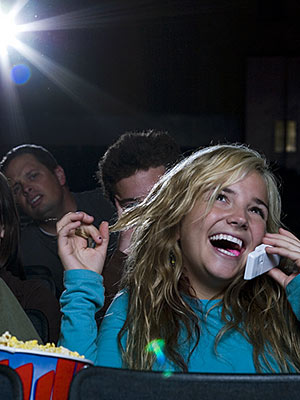
It really irritates me when people use their cellphones during meetings which unnecessarily get prolonged. I get annoyed seeing people talking loudly on their mobile phones even in hospitals. And nothing could be more annoying when a person attends cellphone in the cinema hall.

I had seen some of my colleagues taking their cellphones even to washroom and talking there. What’s there so much to talk in the public creating so much nuisance? To the extent of taking the conversation even to the restroom?!
Still I remember the days, when I was dating my hubby. He used to take me out for lunch or dinner and half the time, he used to be on his cellphone. He used to continuously get calls regarding shoots and I was worried about the situation. He had to promise me that his calls would not disturb us after the wedding and literally, it didn’t work. He used to get calls even at 2.30-3 am. So he had to make up his mind and take a break from his job within 3-4 months of our marriage.

And another fun is to see how people walking on the road talk using earphones or Bluetooth and looks as if they are talking to themselves. The scene is no different in Doha and I see many using their phone even while driving. A lot of men and women keep themselves busy texting and sometimes talking over their mobile phones while driving and it is surprising how they reach their destinations safely!
Whenever I see anybody disturbing people in public, I feel like screaming, but can’t do it. Hope, one day they understand and stop annoying others, I know that would be a daydream!
Why do these text

Wednesday, March 14, 2012

Paris Hilton Syndrome


When I heard about this Paris Hilton Syndrome, I thought it’s about her fashion statement. Partially, yes. It’s not just about her fashion statement, it’s about her Chihuahua which has made people to call Paris Hilton Syndrome! I heard that people in the US are looking out for Chihuahuas, fashionable Chihuahuas to say the least.
Paris Hilton with her Chihuahua
The small trendy dog with pointed ears and oversized eyes is taking up space to a degree never seen before. Stars own them and people are going crazy to own them as well.

Celebrities like Paris Hilton, Britney Spears, Hilary Duff and Mickey Rourke are often seen in public sporting Chihuahuas. Actress Reese Witherspoon’s character in Naturally Blond also had a Chihuahua called Bruiser. These people have helped turn the breed into a fashionable accessory.
Britney Spears with her Chihuahua
I wonder, if people really care for those tiny animals. They might think that Chihuahuas are small and can fit into a handbag that they would have a cool companion. But they should also think that having a dog means giving it a lot of care and training or that the breed is susceptible to sickness and costs a lot of money to keep healthy. They might not feel the pinch of having such breeds till they get high veterinary costs which can ruin the fun of having them at home.
Hilary Duff with her Chihuahua
Small and foreign breeds such as Chihuahua always require good veterinary attention. They are more prone to some genetic anomalies like epilepsy and seizure disorders.
Mickey Rourke with his Chihuahua
Dogs though are true companions of humans, need different diet pattern. Over-feeding them, especially a tiny dog like Chihuahua can be very dangerous. It can shorten the life span as well as lead to diabetes. They should be carefully handled, as not many veterinarians are familiar with Chihuahuas and any injuries and disease may not be properly diagnosed.
Reese Witherspoon with Chihuahua
I feel Chihuahuas can be more prone to eye infections or eye injury due to their large, round, protruding eyes and their relatively low ground clearance. People should take care and see to it that children do not poke the eyes.

I always love dogs and have them around. It’s been my dream that my children should also grow around them. But I make sure that I don’t blindly imitate any celeb to have a dog. I keep in my mind my needs and necessities before owning one. People should think if they have enough space, time and not the least good financial condition to support dogs if they get any foreign breeds.

Monday, March 12, 2012

Easy to remove ex-flame from life, but what about tattoos?


I always wonder what will these celebs do when they split from their partners? Wait, I’m not talking without any reason. The point is these days getting tattoos of boyfriends and girlfriends has become a great trend. They undergo painful moments to show the world that they love their partners truly by getting their names or initials in the form of permanent tattoos. If they split, won’t the tattoos haunt them? Will they go under knife again to remove them? How problematic can tattoos become in one’s career is what I wonder.
Amrita Arora with her tattoo
I used to see floral tattoos on my grandmother’s and my maternal aunts’ hands. They even had small dot tattoos on their forehead, as in Hinduism it is believed that it enhances spiritual well-being and is one of the chakras on the body. They thought it not only warded off evil, but also enhanced their beauty. Then I have seen some tribal women with tattoos and they are so elaborate and intricate that I wonder the amount of time and patience it might have taken for the artist and the amount of pain it caused for the person.
Ajay Devgan with his tattoo
After coming to Doha, I have seen most of my friends, who are westerners, donning tattoos. And I have heard that there is no prohibition against tattoo within the Catholic Church if the tattoo is not an image that is sacrilegious, blasphemous or obscene. And so far, I have not come across any Muslim friend with tattoos, as they are forbidden in Sunni Islam.
Akshay Kumar with his tattoo
And even Judaism forbids tattoos. Since it was a common practice for ancient pagan worshipers to tattoo themselves with religious iconography and names of gods, Judaism prohibited tattoos entirely in order to disassociate from other religions.
Sanjay Dutt with his tattoos
Ok, coming back to the point, I have come across reports wherein celebs, including former Spice Girl Melanie Chisholm and Angelina Jolie, regretting for having tattoos. For Chisholm it is being caught by fans. She often gets spotted when she tries to relax incognito. The singer has 11 tattoos all over her body, including a large black cross on her left arm and a linked chain on her right.
Former Spice Girl Melanie Chisholm
Tattoo of beloved’s name can be a proud thing to sport and ever wonder how tattoos cause problem? When celebs go out in incognito, people recognize them by their tattoos. If they land up in a plum role which requires them not to sport any tattoos, they have to use heavy make-up to disguise them every time they face the camera. For instance, recently, Deepika Padukone was asked to cover up her Ranbir tattoo on her nape by director Ashutosh Gowariker. The director would have not made a fuss if he was not shooting a period film, which had a backdrop of pre-Independence era. Playing the role of a freedom fighter in the story based on the Chittagong Uprising, Padukone was supposed to tie her hair in a bun which exposed her tattoo, which is usually covered by hair.
 Angelina Jolie inked her first tattoo at a very young age. Her first tattoo was a Japanese kanji for the word "Death" and was inscribed on her left back shoulder. It served as a reminder to her to live life to the fullest. She has since covered it up with an ancient Khmer script when she adopted her son, Maddox.
Angelina Jolie with 'death' tattoo
The Blue Tongue Dragon is the first dragon tattoo Angelina inked on her body which she got while intoxicated in Amsterdam. She regretted doing it and has since covered it with a black Latin Cross tattoo. Next to the Latin Cross is a phrase in Latin: "Quod me nutrit me destruit", which means, "What nourishes me, destroys me." 
Angelina with tattoos
Then, she has a tattoo on inner left arm, a quotation from Tennessee Williams: "A prayer for the wild at heart, kept in cages". She had this tattoo done in the presence of her mother, Marcheline Bertrand.
At Angelina's lower back, she has three tattoos: a tribal, a blue window and a tribal dragon. The 'tribal' design was done at the same period when she did the Kanji "Death" tattoo. It is unclear as to the meaning of the 'tribal' tattoo, other than the possibility of it being an 'in' design when she had it inked. At the centre of her lower back is a 'tribal dragon' but now is partially covered by the Bengal Tiger tattoo.
'Know your rights' tattoo on Angelina
The 'window tattoo' refers to her once held view on life: "Wherever I am, I find myself looking out of the window, wishing I was somewhere else." The window has since been covered up by the tail of the Bengal Tiger. She had the window covered because she no longer subscribed to that view and she felt that she is "where she wants to be right now".
Bengal tiger tattoo on Angelina
Besides the Khmer script tattoo, the other prominent tattoo on Angelina's back is the Bengal Tiger tattoo. The tattoo spreads 30 cm long and 20 cm wide and was commissioned to commemorate her Cambodian citizenship. According to a report, it took Sompong Kanphai, the tattoo artist, two hours to complete the design which was done in Bangkok in 2004. While tattooing, the tattoo artist chanted ancient Buddhist hymn to bless the tattoo.
Geo-coordinate tattoo on Angelina
On her left shoulder blade, Angelina has a tattoo done based on a Buddhist Pali prayer written in Khmer script, the language of Cambodia where her son Maddox was born. This tattoo was also done by Sompong Kanphai in a hotel in Pathum Thani, Thailand. She had the tattoo done to 'spiritually' blessed her and Maddox; and to protect them from bad luck and the translation of it is:
May your enemies run far away from you
If you acquire riches, may they remain yours always
Your beauty will be that of Apsara
Wherever you may go, many will attend, serve and protect you, surrounding you on all sides
Billy Bob tattoo
A gothic letter tattoo "Know Your Rights" is between Angelina’s shoulder blades and the phrase is taken from the title of a song of her favorite band "Clash".

Inside her right forearm is an Arabic script tattoo which means "Strength of Will". However some say it means "Determination". But whatever it means, Angelina's interpretation of the tattoo was revealed by her in an interview in a US television whilst promoting her film "Wanted". The Arabic tattoo is a cover up of the abstract tattoo she had together with her former husband Billy Bob Thornton.

On Angelina's inside left wrist is a rune style tattoo of the letter 'H'. According to sources, it is to remind her of her brother, James Haven, whereas some say it is to signify her former boyfriend Timothy Hutton. Knowing her disposition to laser off any reminders of her past relationships, the former meaning is more plausible. On her left arm, Angelina had "Billy Bob" and a Black Dragon inked when she was with Billy Bob Thornton. When she divorced from him she removed "Billy Bob" by laser. After the removal of it, in an interview, she said: "I'll never be stupid enough to have a man's name tattooed on me again."


When she started a family, she had the Black Dragon removed as well and in its place are geo-coordinate tattoos (expressed in the degrees, minutes, seconds notation) of where her children were born :
N 11º 33' 0" E 104º 51' 00"
N 9º 2' 0" E 38º 45' 0"
S 22º 40' 26" E 14º 31' 40"
N 10° 46' 0" E 106º 41' 40"
N 43º 41' 21" E 07º 14' 28" 

N 11º 33' 0" E 104º 51' 00" - pinpoint a spot near a pond somewhere near an airport in the Cambodian capital of Phomn Penh where, purportedly, Maddox, was born. N 9º 2' 0" E 38º 45' 0" - is the coordinate of a house in the Ethiopian capital of Addis Ababa where her daughter Zahara was born. S 22º 40' 26" E 14º 31' 40" - is the coordinate in Swakopmund (Namibian beach resort) where Angelina gave birth to her biological daughter with Brad Pitt, Shiloh in 2006. N 10° 46' 0" E 106º 41' 40" - refers to the coordinate in Ho Chi Minh City, Vietnam where her adopted son Pax Thien was born. The two new tattoos which both read N 43º 41' 21" E 07º 14' 28", were added later showing the birth locations of the hospital in the French city of Nice where her twins, Knox and Vivienne, were born in July.

Finally, Angelina inked an intimate heart shape tattoo on her inner thigh for Brad Pitt. In an interview with MTV, when asked about the tattoo, Angelina confessed: "Um, it's for Brad".

Then there is Megan Fox who has Old English text on her right scapula reading: "We will all laugh at gilded butterflies." This is a reference, not a complete quote, from Act V, Scene III of Shakespeare's tragedy King Lear.
Megan Fox's 'We will all laugh...' tattoo
Megan is obviously a fan of stringing words together with her own personal meaning. Like the large Old English text on her left rib cage: “There once was a little girl who never knew love until a boy broke her HEART”.
'There once was a little girl...' tattoo on Megan
Megan is an obvious fan of Hollywood icon Marilyn Monroe and she has a popular image of Marilyn tattooed on her inner right forearm. On the inner aspect of her lower leg above her right ankle, she has a crescent moon overlapping a five pointed star. It is the one visibly coloured tattoo that she has. Megan had a long term on again off again relationship with actor Brian Austin Green that lasted six years before she married him in the summer of 2010. She has a script tattoo of his first name between her pubic bone and right hip.
On the inside of Megan's left wrist is a tribal tattoo of two waves entwined like a yin and yang symbol. This tattoo has a bit of colour, but looks like black ink from a distance. On the back of her neck just below the hairline Megan has a black ink tattoo of the Chinese symbol of strength in calligraphy. It's a simple tattoo with a strong meaning.
Marilyn Monroe tattoo on Megan
Leave that point, everybody knows that tattoos, like diamonds, last forever. When a person is a celeb and relationships don’t have a long shelf life, why should they risk with them? I sometimes feel that it is their valid proof of stupidity.
Esha Deol with tattoo
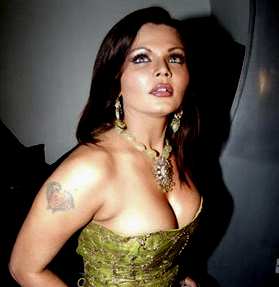
Rakhi Sawant with tattoo
John Abraham with tattoo
Kanagana Ranaut with her tattoo
Khushboo with her tatoo
Mamatha Mohandas with tattoo
Namitha with tattoo
Raveena Tandon with tattoos
Simran with her tattoo
Shruthi Hassan with tattoo
Trisha with her tattoos
What will they do with their tattoos when they end relationship with the person? I think what if they, celebs endorsing some beauty creams, come up with some creams which can erase tattoos also? ;)

Celebs can have one more easy choice. If they can’t erase the tattoos of their ex-flames, will they find another person with the same initials? ;)